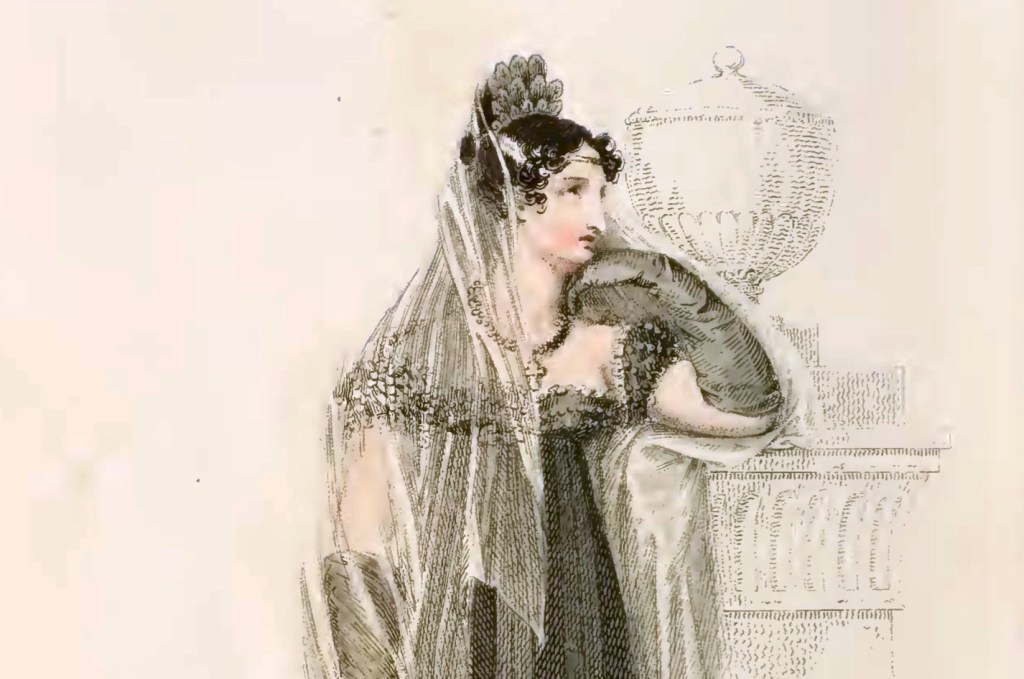
The December 1817 issue of Ackermann’s Repository of Arts was published shortly after one of the most significant events in early nineteenth-century British history and print culture: the death of Princess Charlotte Augusta of Wales. Charlotte’s death on November 6, 1817 marks the first death of either a monarch or direct heir to the British throne since the death of King George II in 1760.[1] Perhaps more importantly, it marks a significant shift in the way print culture responded to, memorialized, and mourned the royal family. While this December issue of Ackermann’s Repository of Arts functions, even in its present archival state, as a visual and textual monument to the memory of Princess Charlotte, it likewise raises important questions concerning the relationship between history and memory as it is represented, experienced, and circulated within a post-Revolutionary (American and French) and post-Napoleonic Britain struggling to define itself as a nation during a period of socio-political and monarchical instability. This issue of Ackermann’s Repository, marks a visual shift in British print culture in which collective mourning and memory enters the realm of mechanical reproduction and circulation. The way print-culture responded to, mourned, and memorialized Princess Charlotte’s death marks the onset of a reimagined nation that collectively clung to memory of Charlotte in anticipation of a feminized monarchy that paved the way for Queen Victoria’s reign.[2]
On November 5, 1817, after fifty hours of labor, Princess Charlotte gave birth to a stillborn heir. Several hours later, on November 6 the Princess died from childbirth.[3]. Had Charlotte outlived her father, she would have become the first female monarch to occupy the British throne since Queen Anne’s death in 1714. She was the only child of the Prince Regent George IV and the only grandchild of King George III.[4] As such, Charlotte’s death produced a monarchical crisis. It left King George III with twelve surviving legitimate children, but no surviving legitimate grandchildren to inherit the throne. Of the twelve legitimate children, “the youngest of the seven princes was aged forty-three and the youngest princess forty.”[5] Four out of the five remaining unwed children who were still likely to procure heirs all raced to get married in 1818 in order to secure the throne for a future succession. This included the next two sons in the direct line of succession after the Prince Regent George IV: William IV and Edward Duke of Kent. It is important to note here that there is a causal relationship between Princess Charlotte’s death and the birth of the next ruling monarch. After Charlotte’s death, her widower Prince Leopold suggested that Edward the Duke of Kent marry his sister Victoria, Dowager Princess of Leiningen. Their daughter Princess Alexandrina Victoria, born eighteen months after the Princess’s death, succeeded to the British throne in 1837.[6]
In the eighteen-month gap between the death of Princess Charlotte and the birth of Princess Alexandrina Victoria, the nation waited with bated breath. By 1817, Britain was ruled by a despised, scandal-ridden King with exiled wife and “an ill-assorted group of royal siblings who seemed indifferent to the nation’s need for legitimate heirs.”[7] The British nation was not only faced with a strained image of the royal family, but was also placed “in jeopardy of falling into the hands of a foreign ruler. Overnight, alarmist pamphlets appeared raising the threat of Jerome Bonaparte acceding to the British throne.”[8] According to Linda Colley, until one of King George IV’s bachelor brothers could be persuaded to “put aside his mistress” in order to marry and procure a legitimate heir, “a posthumous cult of Charlotte, built around her sex, youth, virtue, imminent maternity and tragic demise, seemed one of the few reliable barriers behind which an embattled dynasty, apparently on the verge of extinction, could shelter.”[9] This construction of the “posthumous cult of Charlotte” would not have been possible without print culture’s contributions to the way the Princess’s death was announced, mourned, remembered.
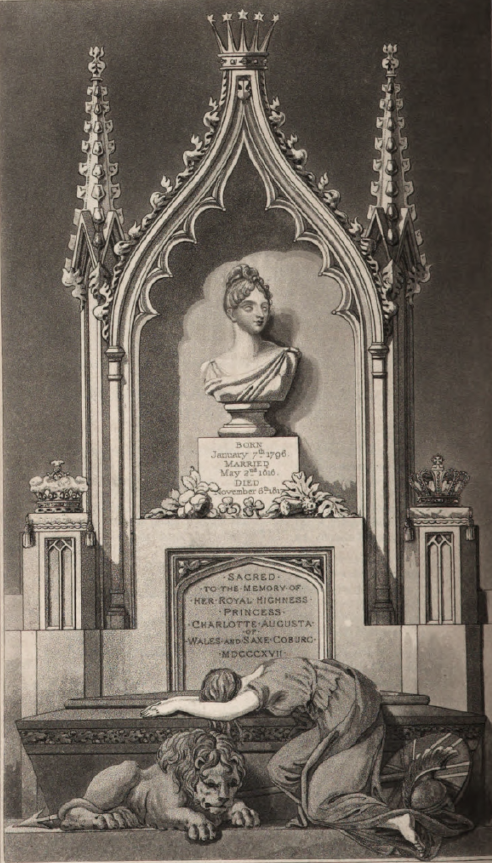
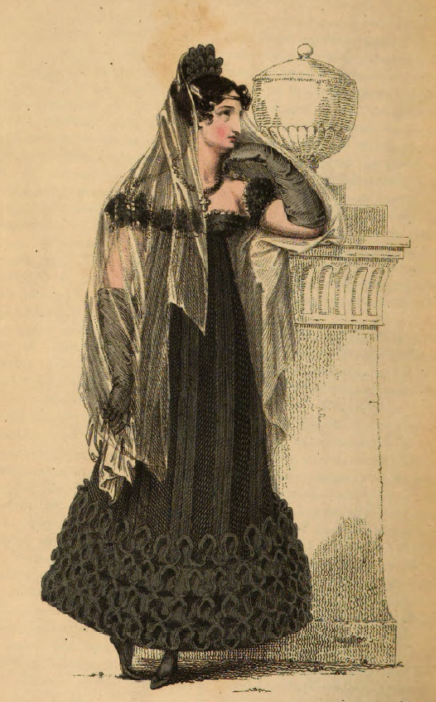
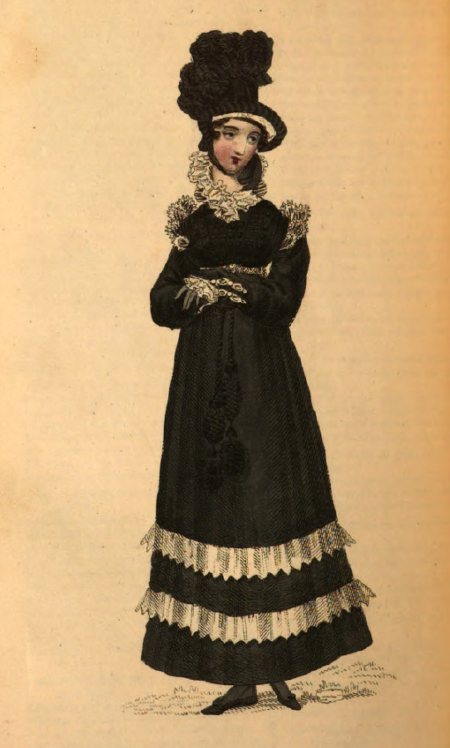
The December, 1817 issue of Ackermann’s Repository of Arts opens with a pictorial monument to Princess Charlotte with Britannia draped over Charlotte’s coffin, embodying the nation’s mourning. It likewise includes a sixteen-page memoir to the late princess, several fashion plates depicting mourning attire, and letters from abroad discussing the mourning practices adopted by British travelers in France. What stands out most, however, is the sixteen-pages dressed in black. Charlotte’s death marks the first occasion that a royal death begins to be published by newspapers, periodicals, and magazines in this way. Linda Colley writes that this practice soon became “the standard practice for subsequent royal casualties, adding drama to reportage and instantly communicating the fact of national loss to those who could only look at print, not read it.”[10]
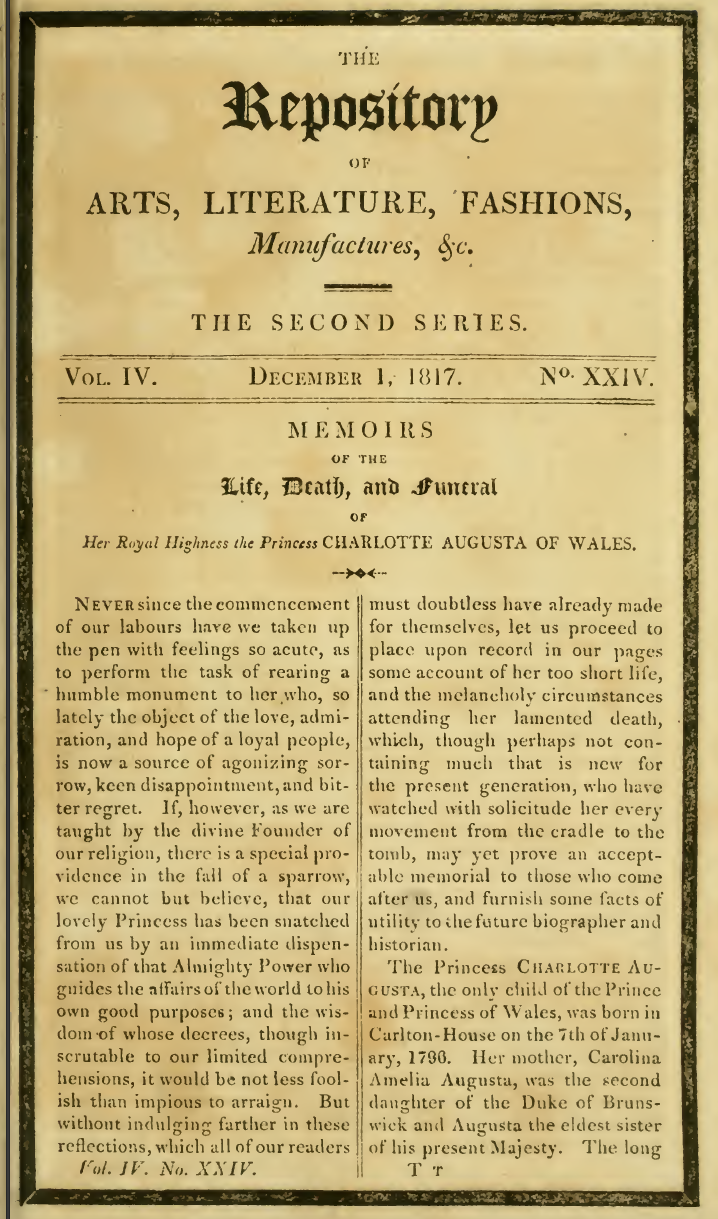
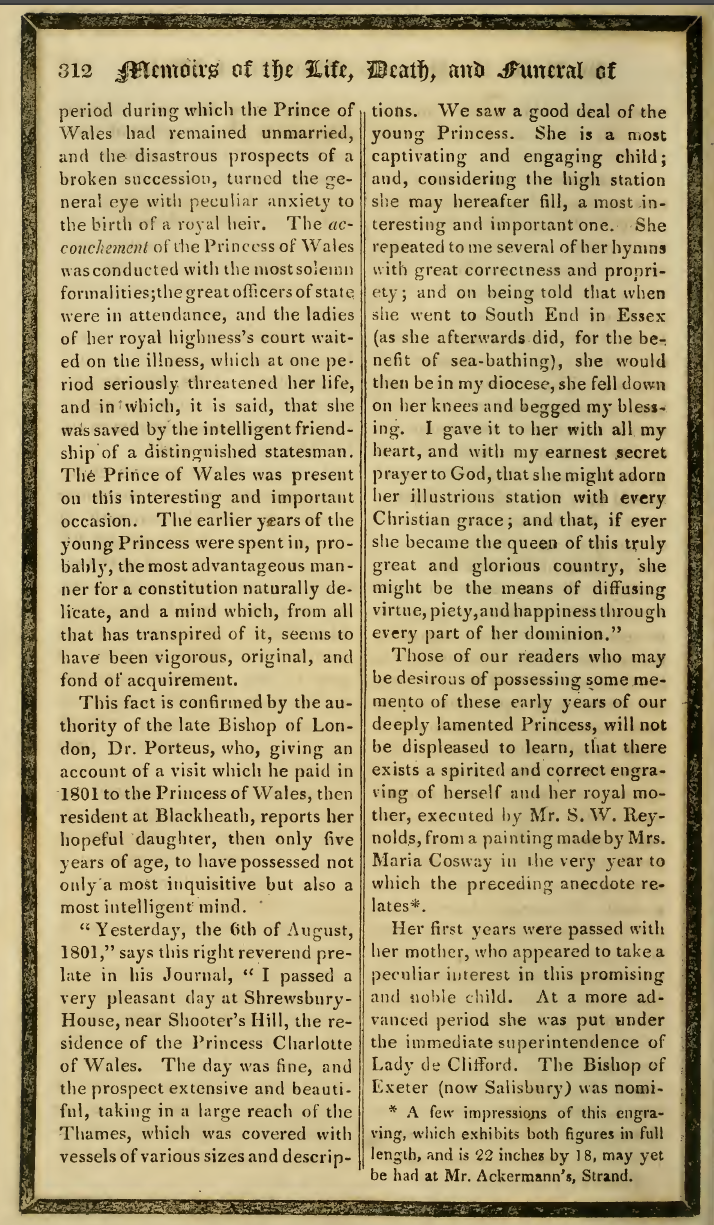
After Princess Charlotte died, these black borders not only absorbed the national grief, worry, and concern regarding the status of the nation, but constructed an “imagined community.” By allowing the readers who encountered these black borders to “think about themselves, and to relate themselves to others” print culture created a “mass ceremony” of mourning that found its expression on the margins of the page. These black borders prevented the Princess’s death from becoming obsolete; moreover, they visually prevented the public from forgetting. The black border stayed on the press for more than a fortnight. We know this, of course, because Ackermann published the December issue approximately twenty-four days after the Princess’s death.
Ackermann’s Repository did something decidedly different from other periodicals like La Belle Assemblée or The Gentleman’s Magazine: it emphasized the nature of the periodical’s investment in the Princess’s death. In the December issue of 1817, Ackermann opens with a “Sketch of a Monument to the Memory of the Princess Charlotte of Wales” which can be read as as both an embodiment of the nation’s grief, but also a prescription for the construction of a monument. Ackermann, in effect, constructs a textual monument to function as a surrogate until a physical monument can take its place (fig. 1). According to Colley, shortly after the princess’s death, “A subscription to build a monument to the dead princess was inaugurated, initially confined to women. All donations were accepted, and no one was allowed to donate more than a guinea; yet the final sum collected was well over £12,000. It went to fund a tremendous marble by Matthew Wyatt which can still be seen in St George’s Chapel at Windsor.”[11] This monument was erected seven years after the Princess’s death. Imbedded in a subscription-based periodical, Ackermann’s textual monument accomplishes a similar subscription-based model for its construction. In doing so, Ackermann makes it clear to his readers that they are all mutually invested in this event, emotionally, monetarily, but most importantly, democratically. According to Renan, the soul of the nation is constructed by two things, the possession of a common memory and “the desire to live together, the desire to continue to investin the heritage that we have jointly received.”[12] Ackermann’s Repository capitalized on print culture’s ability to provide the commodity through which the British nation could simultaneously invest their money, their sympathy, and their imagination. Ernest Renan suggested that between glory and suffering, memories of the latter better help create national identity through shared suffering, claiming that “periods of mourning are worth more to national memory than triumphs because they impose duties and require a common effort.”[13] We can certainly see these imposed duties and common efforts being endorsed by the mourning practices outlined in the periodical press, but Ackermann more than anyone else draws attention to this democratizing moment of a shared effort, a shared investment and, in doing so, makes explicit the construction and production of a shared experience of memory that gives its readers the impression or illusion of having been at the princess’s funeral, in the presence of the crying Prince Leopold, in front of the immaterial monument. In the illusion of attendance, Ackermann’s repository constructed a fiction of a national audience for a national tragedy.
While glory, suffering, and shared memories certainly strengthen the imagined communities of a nation, the essence of a nation “is that all of its individual members have a great deal in common and also that they have forgotten many things.”[14] Perhaps, one of the indicators that print succeeded in constructing a national identity through collective mourning is that by the end of the nineteenth-century, Princess Charlotte had, in large part, been forgotten. By the mid-century the Victorians had become obsessed with remembering in an age which had begun to acknowledge its infinitesimal position in Deep Time. Despite this obsession with remembering, the memory of Princess Charlotte was eclipsed by Queen Victoria. According to Esther Schor, “Queen Victoria was conceived as a result of Princess Charlotte’s death. But as a cultural phenomenon, Queen Victoria was born in the documents” surrounding Princess Charlotte’s death.[15] Through print culture, the nation could suspend their expectations by imaginatively fixing and investing their collective memory into print-capital until the birth of Princess Alexandrina Victoria secured the monarchy, turning the death of Princess Charlotte into yesterday’s news.
[1] John van der Kiste, George III’s Children (Phoenix Mill: Alan Sutton Publishing, 1992), 188.
[2] Benedict Anderson, Imagined Communities: Reflections on the Origin and Spread of Nationalism (New York: Verso Books, 2006), 88.
[3] Esther H. Schor, Bearing the Dead: The British Culture of Mourning from the Enlightenment to Victoria (Princeton: Princeton University Press, 1994), 196.
[4] Kiste, George III’s Children, 188. George IV, the eldest of George III’s fifteen children, became King of Great Britain and the United Kingdom after his father’s death in 1820.
[5] Ibid, 113.
[6] Schor, Bearing the Dead, 228. Had Princess Charlotte and her child survived, it would have meant that there would be a new Coburg ruling House in Great Britain with her son carrying Prince Leopold’s Coburg name. The Coburg dream is reimagined when Queen Victoria marries Leopold’s nephew Albert, securing Leopold’s hopes for a new Coburg ruling House.
[7] Ibid.
[8] Ibid., 197.
[9] Linda Colley, Britons: Forging the Nation 1707-1837 (London: Pimlico 2003), 221. Charlotte had been a favorite among the British public, particularly with women who held a sentimental attachment to the Princess who rebelled against her father, supported her mother, the controversial Caroline of Brunswick, and insisted on marrying Prince Leopold for love, “having earlier rejected the suitor her father had chosen for her” (270).
[10] Ibid, 220.
[11] Ibid, 271.
[12] Renan, “What is a Nation?,” 10.
[13] Ibid.
[14] Ibid., 3.
[15] Schor, Bearing the Dead, 9.
 Jane's Repository
Leave a comment